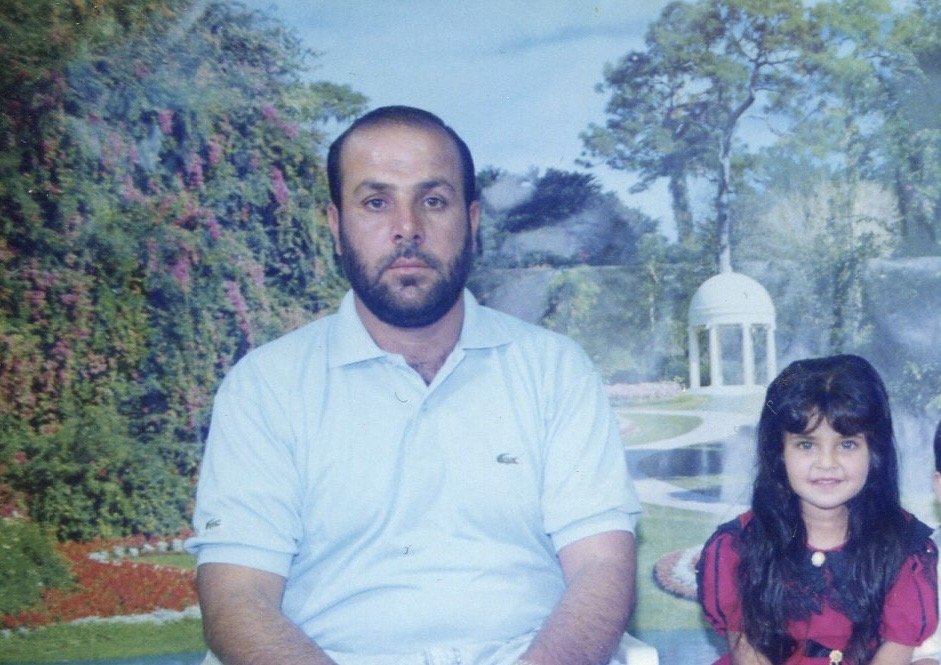
Baba and me, 1996
My dearest baba,
I still do not know how to write to you without first feeling the air change around me, as if the room understands that I am about to reach for someone who no longer answers in the ways I was used to, as if even the walls lean in when I whisper your name.
Baba.
Seven years have passed and I have spent them trying to learn you in your absence, the way one studies a landscape after the river has dried, tracing where the water once moved, where it carved softness into stone, where it left behind something fertile and alive even after it disappeared. I have asked about your childhood in Mdayna, about the dust of Basra that settled into your lungs and your laughter, about the stubborn pride of Bani Manssor men who carried both tenderness and fire in the same breath, about the date palms and the long afternoons and the way you must have walked as a young boy who did not know he would one day have a daughter who would sit across an ocean and try to write him back into the world.
I have learned that you were more complex than I ever allowed you to be when you were alive, that you were softer than your silences suggested, that your quiet was not absence but restraint, that your love was not loud but constant, like groundwater beneath everything, unseen yet sustaining. In the final years we had together, I was so intent on becoming someone you would be proud of that I did not always linger long enough to simply be your daughter. I was always in motion, gathering futures in my hands, certain that time would wait for us. Now I would trade many finished goals for one unfinished afternoon beside you.
Did you know, baba, that after you left this world I began searching for you in the smallest details, in the way I break bread, in the way I press sweetness into the hands of others during thawab and whisper Al-Fatiha under my breath as if the words themselves could travel to wherever you are? I learned that grief is not a single storm but a climate, that it reshapes the body and the voice and the way a woman stands in the world, that it hollows and fills at the same time.
Baba, I returned home and walked where you once walked. I let the soles of my shoes press into the soil of Mdayna and I tried to imagine your younger feet there, lighter, quicker, not yet carrying the layers that later settled onto your shoulders. I drove through Chibayish with Hassan beside me, your nephew tracing the roads with his finger as if he were opening a book about you that I had never read, pointing to homes and saying, here is where your baba would sit for hours, here is where his friends waited for him each year, here is where he was most himself. They told me how animated you were there, how your laughter stretched long into the evenings, how you moved from house to house with an ease that felt almost effortless. I sat in that car stunned by the revelation that you had a version of joy so expansive, so visible, that I had not fully known.
In Canada I had grown used to a quieter version of you, one who held much inside and carried responsibilities that did not always feel light. Hearing about the you of Mdayna and Chibayish expanded you. It taught me that a person can be shaped differently by different lands, that belonging is not sentimental but vital, that the heart requires places where it can exhale fully. It helped me understand that some of what weighed on you here was not who you were at your core, but what accumulated around you over time, the expectations and tensions and complicated dynamics that gather in any life, especially for those of us violently displaced from our homelands. And in understanding this, I began to ask myself where I feel most alive, where my spirit feels clear rather than constricted, and I started choosing more deliberately, pursuing truth and light with a steadiness that I hope honours the expansiveness you embodied there. I try to live in a way that allows me to be whole and present and honest, because I believe that is what you would have wanted for me, and perhaps for yourself.
You used to call me دوكة, ‘my little fried bread,’ warm and golden and soft in the middle, and I did not understand then how much that nickname carried, how it held playfulness and affection and a kind of everyday poetry that only Iraqi fathers seem to master, how it tethered me to kitchen smells and oil crackling and women’s laughter and the quiet miracle of dough transforming under heat. Now when I hear that word in my mind, it lands in my chest with a sweetness that hurts, because it is proof that I was once held in a gaze that saw me as something tender and precious and nourishing.
Since your death, baba, I have been learning myself as well, sometimes against my will, sometimes with a courage I did not know I possessed. I have learned that I am stronger than I ever wanted to be, that strength is not a trophy but a responsibility, that being called strong can feel like being handed something heavy and being told not to drop it. I have learned that I carry you in my stubbornness, in my refusal to accept injustice quietly, in the way I insist on speaking even when my voice trembles, in the way I build and rebuild when things collapse.
I have learned that I am more spiritual than I admitted when you were alive, that loss stripped away the illusion of permanence and left me face to face with Allah in a way that was raw and unfiltered, that I began talking to you as if the veil between worlds were thin and permeable, as if you could hear the rhythm of my days, the exhaustion, the triumphs, the moments when I sit in my car and cry before walking into another room where I must be composed and capable.
I have learned that I am still your daughter in the most ordinary ways, in the way I crave belonging to land and story, in the way I research our lineage and ask about our tribal genealogy and imagine the long line of people whose blood runs in my children’s veins, in the way I try to keep recipes alive and ask my uncle Nouri to write them down so that nothing dissolves into forgetfulness.
And baba, in learning how to live more whole, I have also been learning how to care for my own heart at the same time that I care for my children’s, holding both with a kind of reverence I did not always know how to access. You never got to see me become a mother. You never got to see me lift my daughter into my arms and watch her spin in her silliness and softness and unfiltered girliness, and every time she laughs with that bright, uncontained joy, I think of you and how you adored little girls, how you softened around their playfulness, how you would have been utterly undone by her. You would have called her something sweet and ridiculous, and you would have let her climb into your lap and rearrange your face with her tiny hands. You would have watched her twirl as if it were the most important performance in the world, your eyes crinkling at the corners, your whole body leaning toward her delight.
She tells me sometimes, with a light in her eyes that feels ancient and unwavering, that she is excited to meet her Jaddou in Jannah, as if she is already imagining the embrace, already rehearsing the moment she will run toward you. She speaks of you as someone she is certain belongs to her story, someone waiting just beyond the horizon of this life, and I hold her words carefully because they carry a hope that feels immense.
And Sajjad, baba, he stands in front of your picture longer than I expect him to, studying your face with a seriousness that feels older than his years, and he once told me that your eyes look comforting and loving, and I realized in that moment that even through a photograph, even through time and distance and death, something of your gentleness still reaches us and settles in him. He knows he met you only once, when he was new to this world and could not possibly store the memory, yet he holds that meeting like a quiet treasure, as if the fact of it alone makes him fortunate.
I am raising them inside the values you held with such conviction. I tell them, softly, about 1991, about displacement, about the kind of resistance that cost you everything. We speak about standing firm when something is unjust, about refusing to accept what diminishes human dignity, about what it means to carry your convictions in your body even when the cost is exile. I explain to them that their Jaddou’s journey to Canada was a passage carved by resistance, by sacrifice, by a refusal to surrender his conscience.
I never got to say thank you to you, habibi, for shaping my activist spirit, for planting in me that relentless insistence on dignity and accountability, for teaching me that silence in the face of oppression corrodes something essential in the soul. The work I do traces back to you in ways I only fully recognized after you were gone. My desire to shape a more socially just world for my children and for all of our children carries your fingerprint.
We sit together and recite Hadith al-Kisaa, our voices sometimes steady and sometimes trembling with emotion, and we memorize Quran line by line, syllable by syllable, as if we are building a shelter of words around ourselves that stretches across generations, a living inheritance that binds Iraq to Canada, that binds your endurance to their becoming.
And sometimes, when the house is quiet, I play the voice note I saved of you reciting the Athaan. Your voice fills the room, deep and measured and unmistakably yours, and my children grow still, their bodies instinctively attentive, as if they recognize that they are listening to something that carries both devotion and lineage. In those moments, baba, you move through our home, your call echoing softly against the walls, weaving you into the fabric of our everyday life.
Sometimes I wonder, baba, what you would think of me now, of the woman I have become, of the risks I take, of the public words I speak, of the way I carry our name into rooms that would never have imagined it there. Would you be proud of my defiance, or would you worry about the weight of it? Would you still call me دوكة when I am tired and undone, when the world feels too sharp and I long to be small again?
I have learned that love does not end with burial, that it changes form and temperature and language, that it becomes memory and ritual and responsibility, that it becomes a way of living so that the dead are not erased but integrated into the marrow of the living. I have learned that my grief is evidence of how deeply I was loved, and that even in your absence you continue to shape me, to refine me, to call me toward something larger than my own fear.
There are days when I ache for one more ordinary conversation, one more chance to talk about politics and the news, one more mundane exchange about nothing at all, one more chance to sit near you without knowing it was finite, and there are other days when I feel you so close that I am startled by it, as if your روح brushes past mine and reminds me that this life is only one chapter in a longer story we cannot yet see in full.
Your دوكة is still here, still reaching for you, still becoming.
Always your daughter,
Salsabel